Sciatic nerve
Used for pain that travels from the lower back or buttock down the leg and may help relieve irritation contributing to sciatica.
A minimally invasive ultrasound-guided procedure that uses saline and dextrose around a nerve to reduce irritation, pressure, and scar-related restriction.
A minimally invasive ultrasound-guided procedure that places fluid around an irritated nerve to ease pressure, release scar tissue, and reduce pain.
Used for pain that travels from the lower back or buttock down the leg and may help relieve irritation contributing to sciatica.
Used for carpal tunnel symptoms such as numbness, tingling, or weakness in the hand and fingers, including patients hoping to avoid or delay surgery.
Used for numbness or tingling in the ring and little fingers, pain along the inner forearm or hand, and symptoms related to cubital tunnel syndrome.
Used for localized abdominal wall pain, including pain after surgery, injury, or strain.
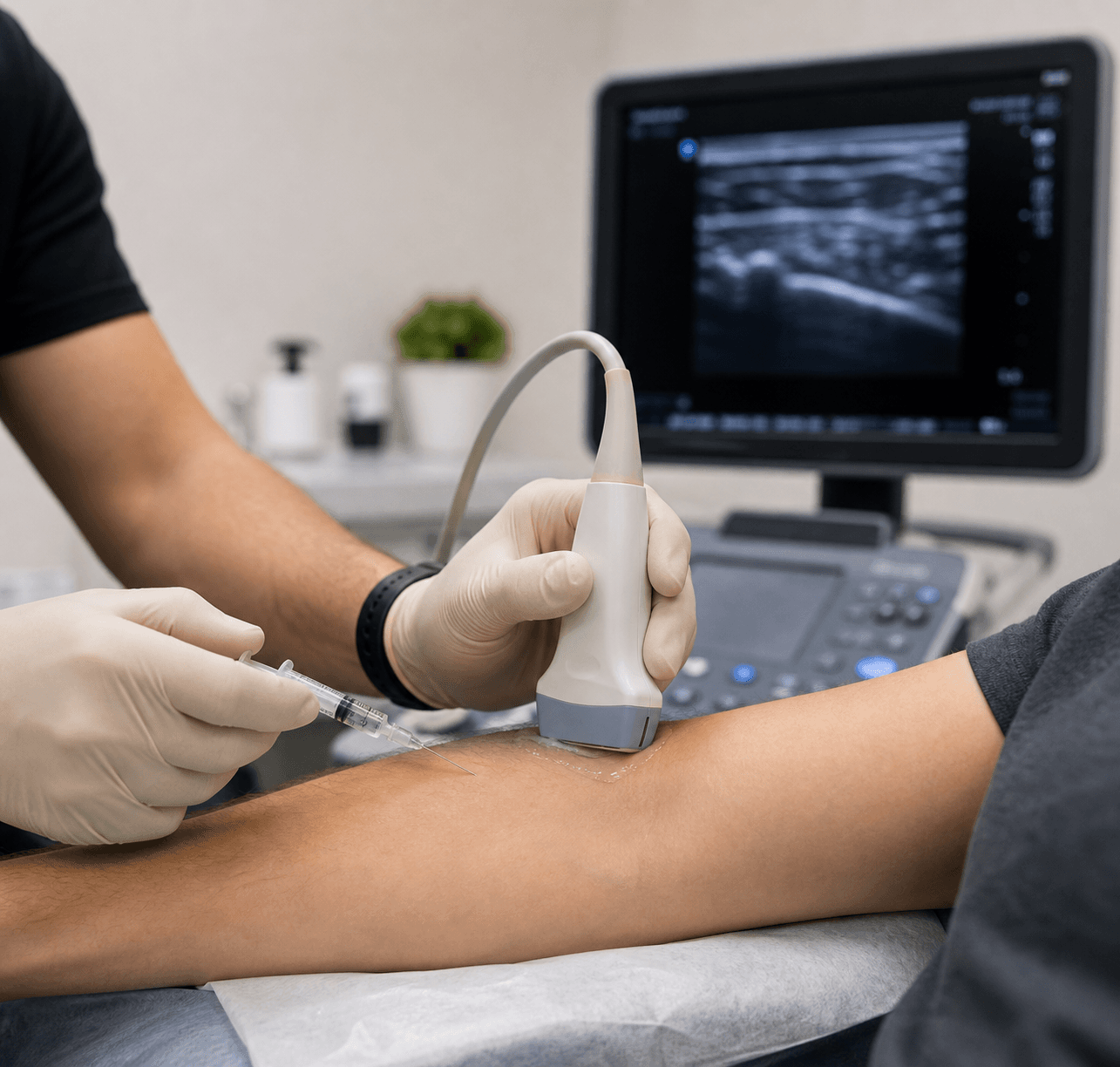
Ultrasound guidance helps separate irritated nerves from surrounding tissue.
The experience after nerve hydrodissection varies from patient to patient. Some notice improvement shortly after the procedure, while others find that relief builds gradually over several days to weeks as inflammation decreases and the nerve settles.
Nerve hydrodissection is chosen when a nerve appears to be restricted, irritated, or under pressure from surrounding tissue, and when a minimally invasive approach is appropriate.
The procedure does not involve surgery. Ultrasound guidance allows the physician to visualize the nerve in real time and place the fluid precisely. Recovery is generally brief, and most patients resume light activity within one to two days.
The clinic can review your symptoms, prior treatment, imaging, and whether this procedure fits into your care plan.
If you have a question after a recent procedure, call the clinic directly rather than waiting for an online response.